The Church and Science
Church and science discussions seem to follow the same tired pattern. The same handful of personalities keep showing up and only one discipline (astronomy) seems worthy of discussion. Cherry-picking a few events over a 2000 year span doesn't really tell us much. A broader look at the history of science would be a good start. Paying more attention to science as it is practiced today would also help. And lastly, sticking to facts might help as well. Church and science discussions are rife with myth.

The image above (taken from Eigenfactor-Map of Modern Science) maps the activity and influence of the disciplines of modern science. It is based on citation behaviour in modern scientific journals. Church and science discussions focus on the small bubble that is Astronomy and Astrophysics and largely ignore everything else. Maybe it is time to look at the rest of the map as well.
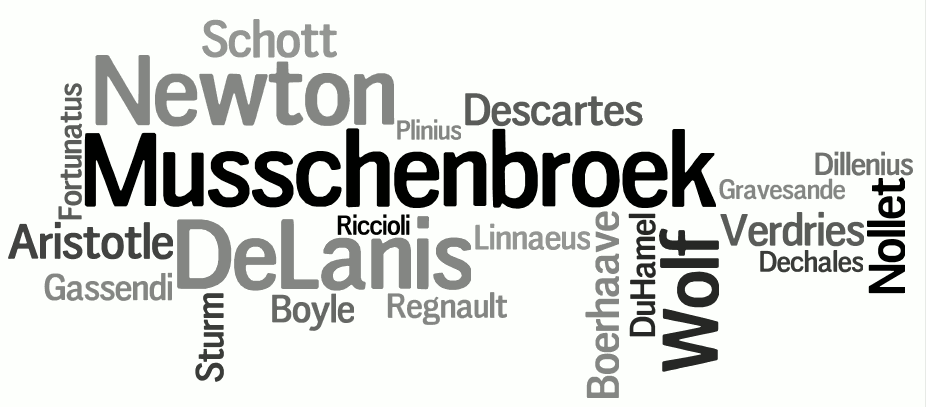
The image above is a word cloud of the scientists that were most cited near the end of the Scientific Revolution (see Galileo's Contemporaries). These scientists studied a broad range of topics including classical mechanics and optics (Newton), atomism (Gassendi),electricity (Musschenbroek,Nollet), aeronautics (de Lanis) and hydraulics (Shott). Galileo is not in the word cloud, but Galileo's contemporaries, Gassendi,Riccioli and Descartes, are. Gassendi and Riccioli were Catholic priests. So were Nollet, Schott, de Lanis, and deChales. These priest-scientists are typically ignored in church and science discussions.
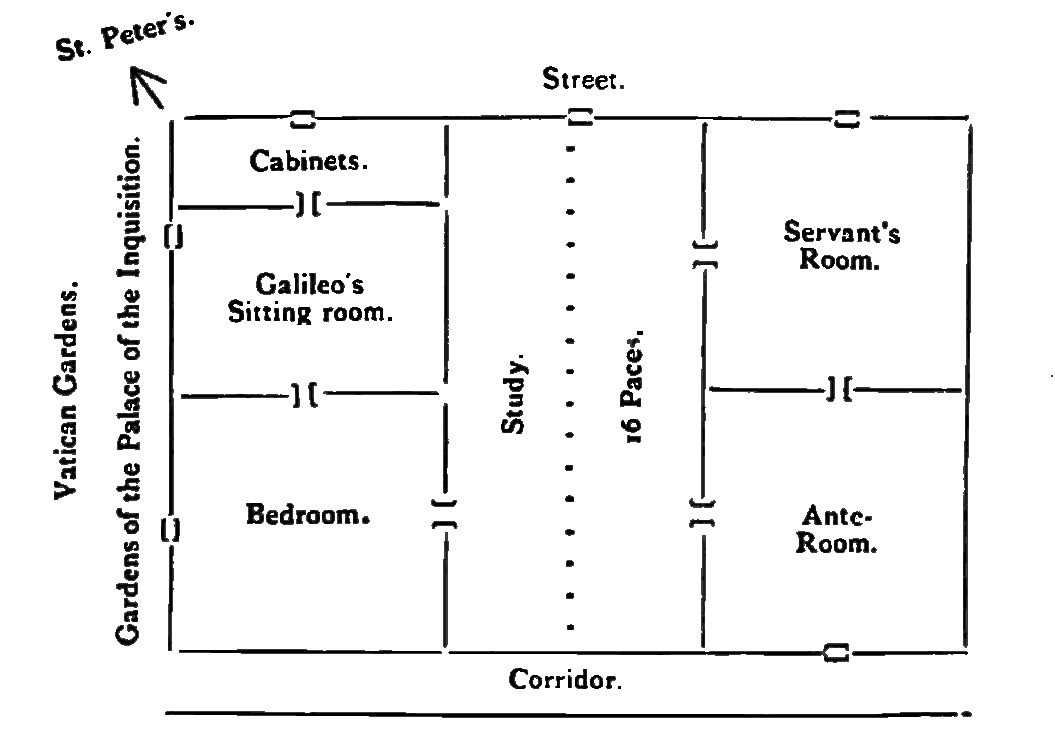
The image above is the floor plan of Galileo's luxurious quarters during his famous trial. While in these quarters, Galileo was even given the choice of which type of gourmet food he would prefer. This luxury doesn't fit well with narratives that portray Galileo as a martyr. Carl Sagan referred to these quarters simply as a dungeon (see Galileo's Dungeon). While this is disappointing, it is only one of dozens of myths that commonly circulate in church and science discussions (see Galileo Myths).
It might be time to change the discussion of the church and science. Maybe it should go beyond one discipline. Maybe the use of myth should not be passively excused. And maybe the practice and enablers of science should be included (see Modern Science). That is what this site attempts to do.
Copyright Joseph Sant (2019).
Cite this page.
Sant, Joseph (2019).The Church and Science. Retrieved from http://www.scientus.org/index.html
HTML Link
<a href="http://www.scientus.org/index.html">The Church and Science</a>