Galileo's Battle for the Heavens
Looking for older page. It's here
The NOVA documentary, Galileo's Battle for the Heavens, presents the heroic struggle between Galileo and the church for his vision of the cosmos. This drama, the Galileo Affair, is the story of a man guided by facts and reason. In Against Method, Paul Feyerabend also presents Galileo as a heroic figure. For Feyerabend, Galileo's guide was more intuition than facts. Feyerabend believed that great science must sometimes work against the facts. He demonstrated that Galileo's commitment to Copernicism did not agree with facts known at the time. Galileo, a hero in the struggle between faith and reason, was himself going more on faith than reason.
Galileo's Straw Man
Galileo's argument for Copernicism was a straw man. In a straw man argument, you create or choose an opposing argument that is easy to defeat, then proceed to destroy it. Your own argument wins by default. In the Dialogue Concerning the Two Chief World Systems, Galileo argued for the Copernican Model against the Ptolemaic Model. The problem with Galileo's argument was that there were at least 5 "chief world systems"! And the Ptolemaic wasn't one of them [_1_] . It had been discarded because its flaws had been recognized.
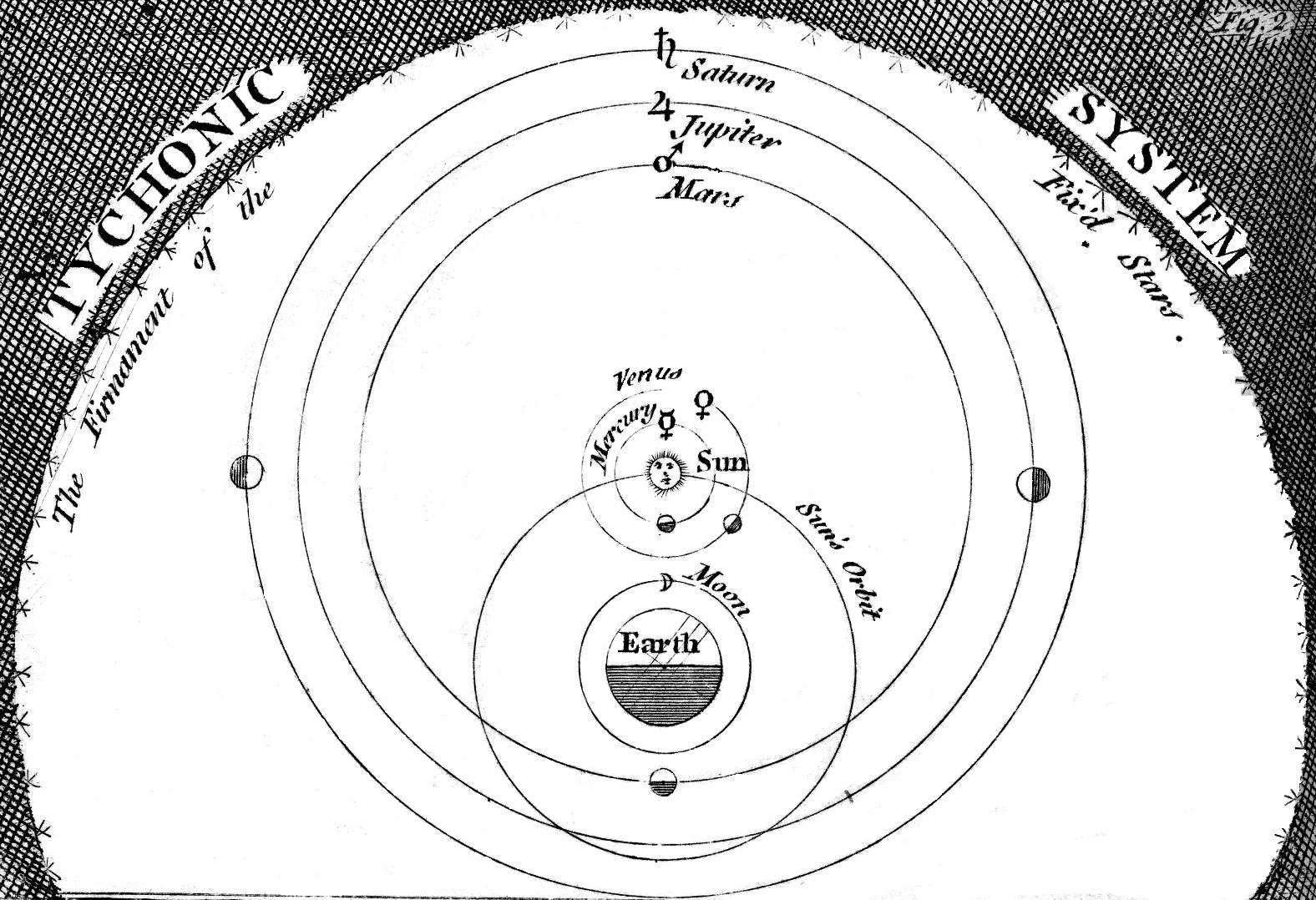
Galileo's Battle for the Heavens, like most discussions of the Galileo Affair, has fallen prey to Galileo's Straw Man. The program only ever mentions the Copernican and the Ptolemaic models. Early on, Galileo's Battle for the Heavens describes Galileo's discovery that Venus went through phases. This could only be explained if Venus was orbiting the Sun and not earth. This definitely contradicts the Ptolemaic Model. But Venus did circle the sun in all the models that were popular at the time. Three were geo-heliocentric (Tychonic, Capellan, Ursine) where some bodies circled the sun and some the earth. Two were heliocentric (Copernican and Keplerian). You wouldn't know this from the program. The diagram of the Tychonic system below shows how Venus can circle the sun in an earth centered system.
The Galileo Affair-The Elephants in the Room
Johannes Kepler was never mentioned during the entire duration of Galileo's Battle for the Heavens. This is odd. Kepler lived at the same time as Galileo and the two had even communicated. His contributions in astronomy and optic were important to understanding Galileo's contributions in both areas. Like other discussions of the Galileo Affair, it is more about the conflict between science and the church than science or history. Kepler is "awkward" for these discussions. But Kepler is only one of four elephants in the room that are avoided:
- Johannes Kepler
- The Church and Other Copernicans
- Stellar Parallax
- Tests of the Copernican Model
Johannes Kepler
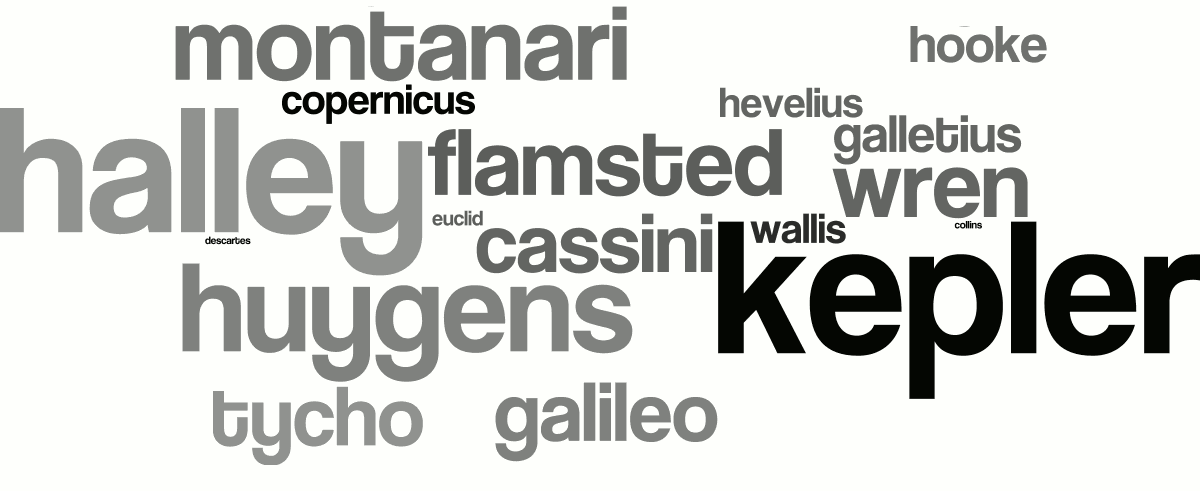
Kepler's contributions to optics and astronomy were recognized in his day and in the years following his death. You can see this in the word cloud (see wordle.net) of references to scientists in Newton's great work,Philosophiæ Naturalis Principia Mathematica below. Galileo narratives might ignore Kepler because Galileo had. He wrote that he did not want to seek out "the nuggets of real gold in Kepler's heap of dross" [_2_] . This means that he ignored his 3 laws of planetary motion, his belief that the tides were caused by the moon, and his suggested design for refracting telescopes. Today's refracting telescopes are based on Kepler's design not Galileo's (see Jesuits and the Telescope).
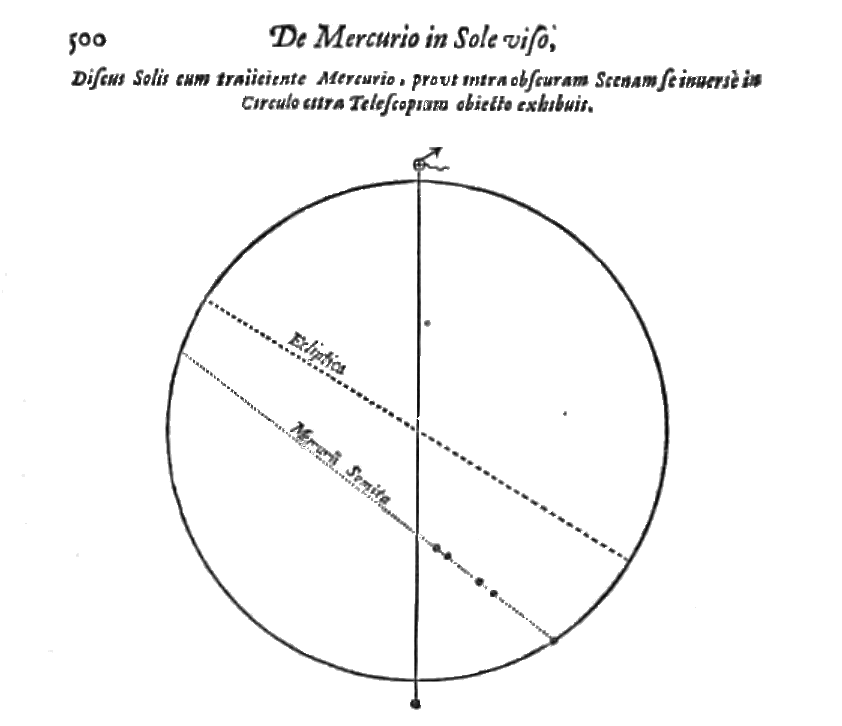
Kepler's model predicted that Mercury should pass between the sun and the earth on November 7, 1631 (see Gassendi's Transit of Mercury), two years before Galileo's trial. Pierre Gassendi, a Catholic priest, realized that this could be a good test of the Keplerian model against the other models. He forewarned noted astronomers across Europe of the upcoming event. The transit of Mercury happened very close to the time Kepler predicted. The error of the Copernican and Ptolemaic models was 30 times larger than Kepler's model [_3_] . Galileo knew of the experiment but didn't let it shake his commitment to the Copernican model. Gassendi's record of the event is shown in the diagram below.
Galileo had chosen the "wrong horse" with the Copernican Model and stuck with it. But being wrong is not so bad in science. Science is more about how you are right or wrong than whether you are right or wrong. Galileo had good reasons to hang on to his model even with its flaws, just as his contemporaries had reasons to hang on to the Tychonic and Capellan models. Gassendi's Transit was a noteworthy support for Kepler's model, not a scientific proof. For most Galileo narratives being right or wrong is all there is. They vilify those that disagreed with Galileo for being wrong, without realizing that so was Galileo.
The Church and Other Copernicans.
The Galileo Affair is much more than the story of a Galileo's clash with the church over the Copernican model. It is used as a symbol of the conflict of the church and science. There were other Copernicans as important as Galileo; Copernicus and Kepler. If the Galileo Affair is a legitimate symbol, we should expect Kepler's and Copernicus's experience to be similar. It wasn't.
Kepler's most loyal supporters were the Jesuits from Linz, Austria. He used the appendix of his last book, the Somnium, to thank them for their loyalty. And Kepler wasn't even Catholic, he was an excommunicate Lutheran. Kepler used the network of Jesuit institutions as his private postal service. The Jesuits were the first champions of Kepler's refracting telescope design (see Jesuits and the Early Telescope). They had their master telescope maker, Niccolo Zucchi, build him a telescope. They even chased down and returned a manuscript that had been stolen from him.
Copernicus's experience doesn't support the Galileo narrative either. The plans to publish Copernicus's theories were hatched in the home of the Catholic bishop of Culm. Bishop Tiedeman Giese had invited Copernicus and his collaborator, Rheticus, to his home with the hope of convincing Copernicus to publish his works. Copernicus agreed, but only to publish the tables associated with the theory. Giese convinced Copernicus to publish an explanation of his theory as well [_4_] . Giese and Rheticus succeeded where the Vatican had failed. The Vatican had found out about Copernicus's ideas through seminars given by Johann Widmanstetter in 1535. The Vatican was impressed and followed up with a letter to Copernicus asking that he publish his works with a promise to pay for the publication (see Schonberg's Letter). Copernicus had ignored the letter.
A timeline of Copernicus's life is here and a list of the most common Copernican myths is here. Copernicus was orphaned at about the age of 10. From that time until his death he was either in the employ or care of the church. The relations of Copernicus and the church throughout his life denote mutual respect and service.
Stellar Parallax
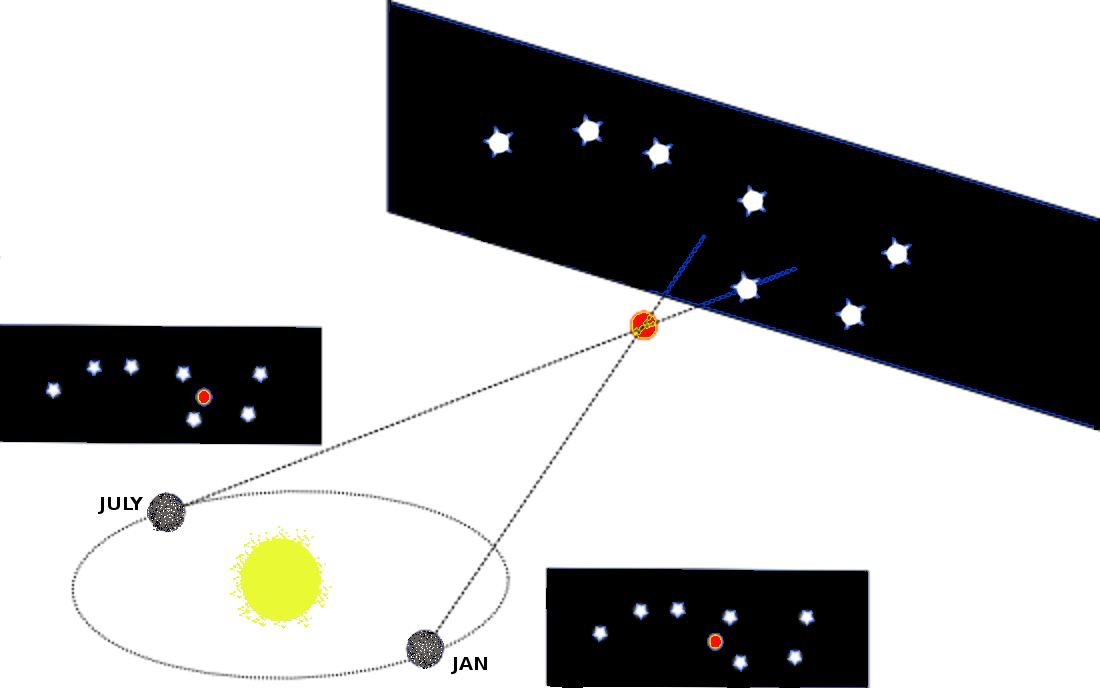
The Copernican model featured a moving earth with the sun being stationary. There are necessary consequences of a moving earth. One is stellar parallax (see Copernicus and Stellar Parallax). If the earth was moving relative to the sun it demands that viewers on earth be able to see some change in the relative positions of nearer and distant stars over the course of a year. No-one in Galileo's time was able to detect any change in the positions of the different stars. Stellar parallax was eventually detected, but not until 1838.
Tests of the Copernican Model
If you compare the predictions of the various cosmological models (excepting the Keplerian) and compare them to a record of astronomical observations (an ephemeris) you will find they perform about the same. This has been confirmed by modern computer-aided analyses [_5_] . Galileo, his contemporaries and even Copernicus knew that the Copernican Model did not seem to fit the data any better than its competing models. The Copernican Model used perfect circles when an accurate model required the use of Kepler's ellipses.
The Galileo Myths
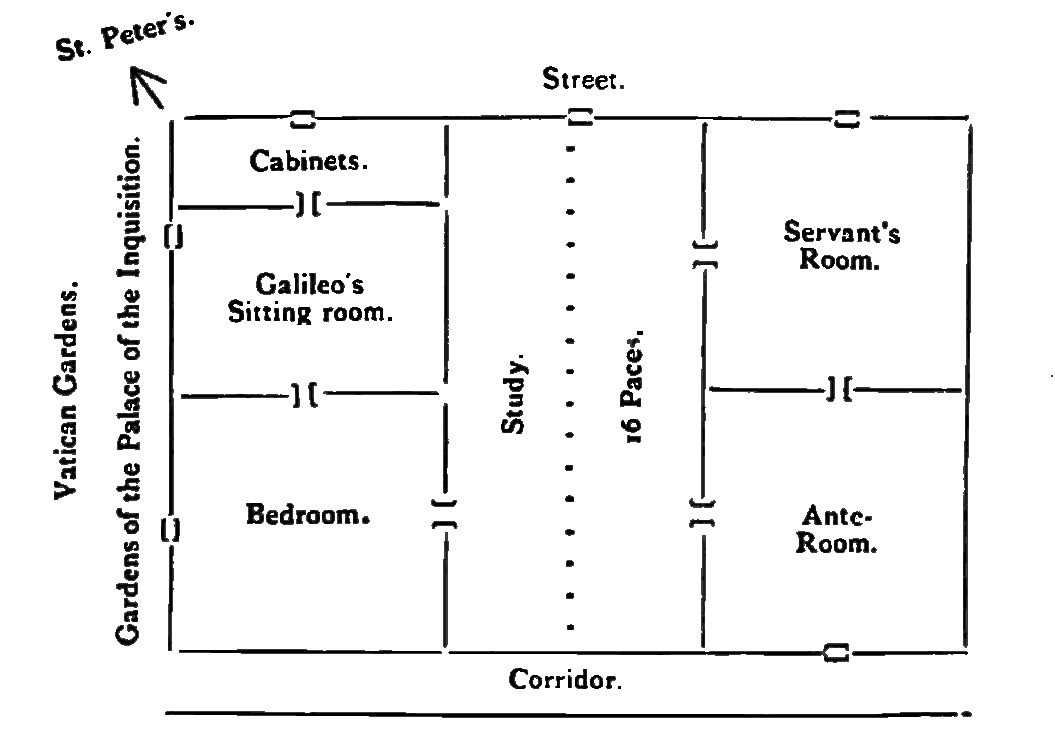
Sadly, Galileo's Battle for the Heavens and its associated website repeats several common myths about Galileo (see The Galileo Myths). This from an award-winning documentary that is used widely in science education. Galileo was not "remanded to a small room in the Palace of the Inquisition". It was a large 5-room suite that came with a personal valet and room service that included the finest of Tuscan food. The floor plan is shown below. Galileo didn't drop any balls from the Tower of Pisa. Todays astronomical refracting telescopes are derived from Kepler's designs not Galileo's. He didn't 'discover' the law of free fall. Galileo didn't discover the law of the pendulum from watching a chandelier swinging in the Pisa cathedral. Galileo didn't die the same year that Newton was born. And Galileo wasn't novel in describing natural events in mathematical terms. He was continuing a Calculatory tradition established centuries before ( see The Calculatores).
Galileo and the Church
Galileo was 69 years old when The Galileo Affair occurred and he died when he was 78. Discussions of Galileo's relation to the church typically focus on the last nine years of his life. It might be instructive to look at all 78 years of his life.
Up until the Galileo Affair, Galileo had enjoyed the favour of the church. Pope Urban VIII had arranged for life-long monetary support for Galileo's research [_6_] . His close friends included Archbishops and Cardinals in the Inquisition, one of whom was the nephew of the pope. The main clients for his telescopes were Roman Catholic Cardinals. He had many other friends who were clergy. His early astronomical discoveries were celebrated by the Jesuits of the Collegio Romano and even earned him an audience with the pope.
Galileo was called before the Inquisition over Copernicism in 1615, more than a decade before the Galileo Affair. The end result of the interviews was that Copernicism could not be "held as true" but that it could be discussed in a hypothetical manner. Cardinal Bellarmine accepted the possibility that Copernicism was true, but that there wasn't sufficient proof at time. If sufficient proof was provided, the interpretation of Scriptures would need to be revisited [_7_] . Cardinal Bellarmine was on good scientific grounds here. Galileo's proofs wouldn't be accepted by today's scientists (see Copernicus and Stellar Parallax). On a side note, during Bellarmine's investigation, he had consulted with the Jesuits of the Collegio Romano about Galileo, and they had given him a glowing recommendation.
Galileo generally maintained good relations with the senior hierarchy of the church, especially the pope and several important cardinals. The relationship with the Jesuits in Rome did sour over time. Galileo was quick to accuse others of plagiarism. He unjustly accused Christopher Scheiner and Orazio Grassi, both Jesuits of the Collegio Romano, of plagiarism. Knowingly claiming credit for Christopher Scheiner's discoveries probably didn't help relations with the Collegio, either. Rash accusations, claiming credit for other peoples accomplishments and spurious insults can turn off your admirers (see Apelles hiding behind the painting).
The lead up to Galileo's trial is often ignored. Correspondence from the time suggests that Pope Urban VIII was privately sympathetic to Copernicism, even though he didn't want to publically admit it [_8_] . The pope's endorsement (imprimatur) was promised for Galileo's Dialogo with the understanding that it would be an objective presentation of the strengths and faults of the different cosmologies. Galileo's Dialogo clearly advocated the Copernican model. It was published with the Pope's endorsement (imprimatur) right after the title page. This greatly compromised the Pope. since it could be interpreted that the church was publicly endorsing Copernicism. At the time Copernicism was still contentious from both a scientific and theological viewpoint.
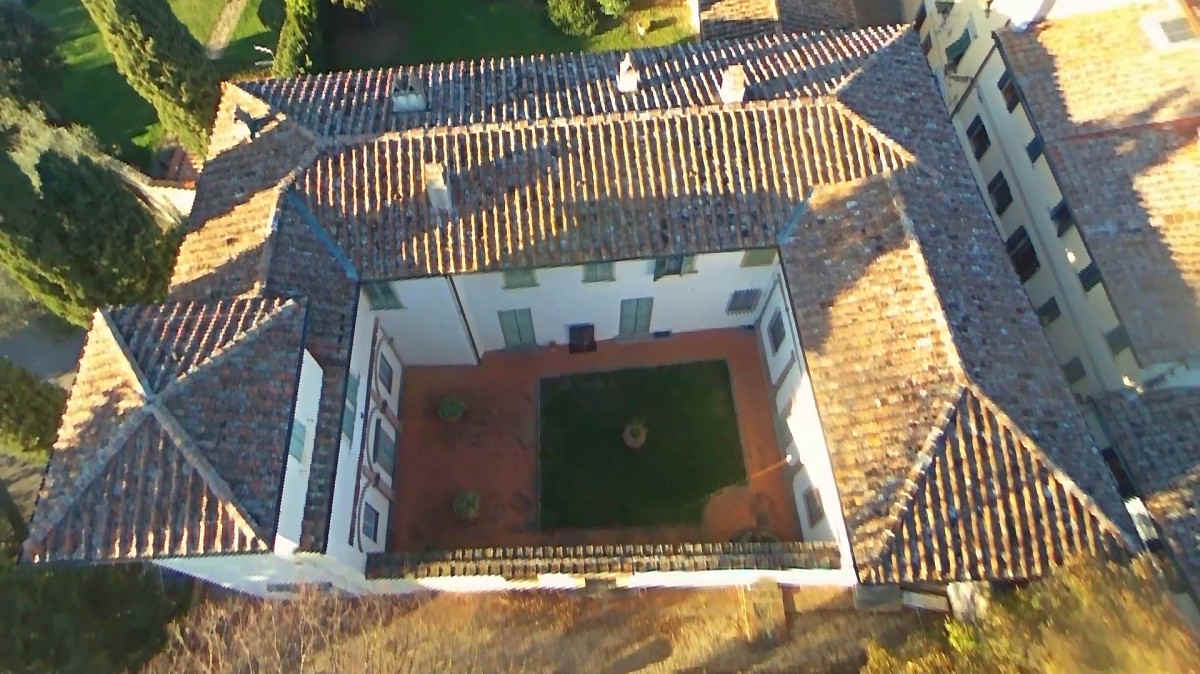
Galileo's trial ended in 1633. It is generally agreed that both the verdict and punishment were excessive even by the statutes of the Holy Office. Three of the cardinals of the Inquisition, including the pope's nephew, abstained from the verdict. Even so, many Galileo narratives see a need to embellish both the verdict and the punishment. Galileo had lived a life of luxury beyond his birth from about the time he left Pisa. That did not end with the trial. In fact, there is no indication that the church's monetary support (via prebends) for him was discontinued. Galileo was confined to the area around Arcetri. An aerial view of Galileo's summer villa in Arcetri is shown above (sourced from here). The villa was leased from one of the richest banking familes in Florence (the Martellinis). Galileo did not have to curtail his love of wine because the wine cellar stored the equivalent of 1200 bottles. His villa was known as Il Gioello (The Jewel) because of the beautiful view overlooking the Arno valley. He had live-in scientists to help him with his work. And he continued to receive famous guests, including John Milton and the Medicis.
It is a bad idea for the untrained to interpret legal text even if one understands its literal meaning. The application (or implication) of the text is what's important. Galileo narratives go one further, in trying to interpret the translation of Latin legal text from 400 years ago. This is irresponsible. "imprisoned" and "house arrest" meant something different to Cardinals of the Inquisition 400 years ago in Italy than it does to English-speakers of today (see Galileo Myths). For the Holy Office, formal heresy was a very serious charge. Galileo's charge of "vehement suspicion of heresy" was on the scale of missing services on holy days or eating meat on Friday(see Galileo Myths).
Straw Men, Elephants and Science
By the end of Galileo's Battle for the Heavens, the program had successfully built and destroyed a straw man and had successfully navigated around all the elephants in the room in the Galileo Affair. In the process it missed the most important scientific issues. That is because the program, like many discussions of the Galileo Affair, was not about science (see Modern Science). This is signalled by the program's own byline: "Witness Galileo's famous struggle to persuade church authorities of the truth behind his discoveries about the cosmos". Persuading people of the truth is the stuff of debating clubs not scientists. Being right is not good enough in science. 'How' you are right matters. Your proofs must be valid. This is as true today as it was 400 years ago (see Wegener and Galileo).
Copyright Joseph Sant (2020).
Cite this page.
Sant, Joseph (2020).Galileo's Battle for the Heavens. Retrieved from http://www.scientus.org/Galileo-Battle-for-Heavens.html
HTML Link (For Use in HTML Web Pages)
<a href="http://www.scientus.org/Galileo-Battle-for-Heavens.html">Galileo's Battle for the Heavens</a>